

Olivia Rodrigo face shape is commonly described as heart-shaped, though that label isn't settled. In a 2023 WIRED interview, Rodrigo tentatively called her own outline heart-shaped and said she could be wrong. Team YouCam's 2022 guide instead placed it in the inverted-triangle group. Across public photos, the recurring impression is a broader upper outline and a jaw that narrows toward the chin. Her outline can read as either label depending on the photo.
What the published labels actually say
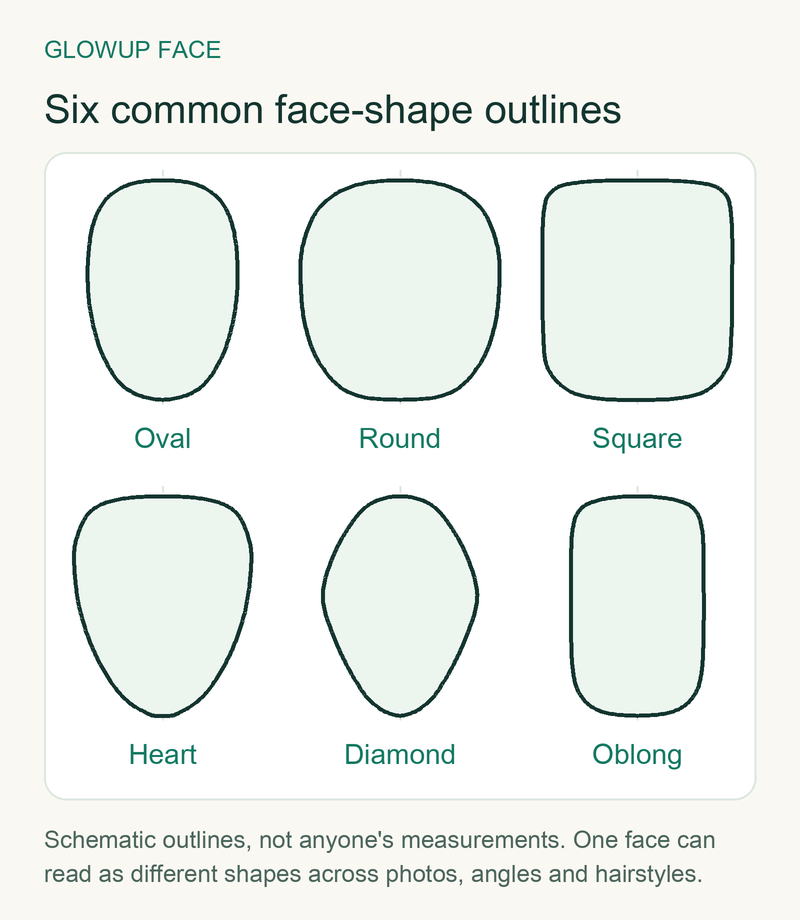
WIRED provides the clearest first-person description. Rodrigo used the heart-shaped label while sketching herself, but framed it as a guess. It wasn't a formal classification.
Team YouCam, writing for Perfect Corp, chose inverted triangle. Its guide treats that shape as a broader forehead tapering to a narrower chin. The page doesn't explain which photos it compared or how it classified them. That makes its label an editorial judgment, not a measured finding.
The two labels overlap. Both describe an upper outline that reads broader than the lower jaw. The disagreement often comes from how a writer interprets the hairline, forehead curve, jaw corner, and chin.
Of the checked named sources, heart-shaped has the clearest attribution because Rodrigo used it herself. Still, her wording was cautious, and the second source chose a neighboring category. Search results vary by location. This review checked pages accessible on November 1, 2026, but couldn't reproduce every US searcher's exact result set.
How her outline can read in public photos
In front and near-front views, the forehead and cheek area can read broader than the jaw. The face can also look slightly longer than broad. Jaw corners appear soft, while the lower outline narrows into a rounded chin.
Those cues don't produce one permanent label. A clear upper outline supports heart-shaped. Hide part of the forehead, turn the head, or emphasize the cheek area, and the same outline can read closer to inverted triangle. These are visual impressions, not physical measurements.
Why the label changes between photos
Camera distance and lens choice
Camera distance changes apparent facial configuration. Noyes and Jenkins reported this effect in Cognition in 2017, even when the final images appeared at the same size. Lens choice often changes how close a photographer stands to fill the frame. Distance then drives the perspective shift.
A close shot makes nearer features loom and changes the visible relationship between the center and outer outline. A longer working distance usually looks flatter. Our guide to selfie distortion and face shape explains how to compare photos more fairly.
Head angle
A turn hides part of one jaw edge and shortens the visible side of the face. Looking up or down changes how much forehead and chin the camera sees. Witkower and Tracy showed in Emotion in 2022 that head position systematically changes the appearance of facial features.
Expression
A smile changes the visible outline. Farnell and colleagues found wider mouths, more prominent cheeks, and narrower-looking eyes in their facial-image analysis. Their 2019 Journal of Imaging paper used controlled research sets, not celebrity photos or styling labels.
That means a smiling event photo and a neutral portrait aren't clean comparison inputs. Read how smiling changes face shape in photos before treating the difference as a new category.
Hair over the forehead or jaw
Hair becomes part of the border your eye reads. A fringe can hide the upper outline. Loose front pieces can soften or partly cover the jaw. Hair tucked behind one side exposes more of that edge.
Vogue's 2021 profile of hairstylist Clayton Hawkins documented Rodrigo's varied hair choices. Byrdie later reported that Hawkins switched her part during a 2024 event. Even within one appearance, styling can change which outline is easiest to see.
The year of the photo
The year matters because the cut, part, brow styling, and eyewear may differ. Compare photos from a similar period before calling two labels contradictory. You may be comparing two different frames around the same face.
Turn the outline into styling options
The table below is an editorial illustration. It uses generic outline cues and hypothetical styling options. The rows aren't measured people or product results.
| Outline feature | Why it can read differently between photos | Styling option for a reader with that feature |
|---|---|---|
| Upper outline appears broader than the lower outline | Hair over the temples can hide the border, while head position changes how much forehead is visible. | Try an off-center part, light curtain pieces, or frames with more detail along the lower rim. |
| Cheek area looks like the broadest point | A smile makes the cheeks more prominent, and close camera distance changes the apparent configuration. | Start face-framing layers below the cheek area, or try softly angular frames that clear the cheeks. |
| Jaw narrows toward a rounded chin | A three-quarter turn hides one jaw edge. Tucked or loose hair changes how much of the jaw remains visible. | Try texture near the chin, a collarbone cut, or frames with a clear lower edge. |
| Outline reads longer than broad | A tight crop and flat hair at the sides increase vertical emphasis. | Try side volume, a shorter front layer, or a frame with more depth. |
What to borrow for hair, brows, and glasses
Haircut
Don't copy a celebrity cut without checking your texture, density, part, and styling time. For a broader upper outline and tapered jaw, you might add movement near the lower face. An off-center part or soft front pieces can also change the emphasis.
Use the heart-face hairstyle hub as a menu, not a rulebook. Bring two references to your stylist and name the feature you want: lower-face movement, a visible forehead, or a softer jaw border.
Brows
Start with your natural growth. A gentle curve can echo a softer jaw, while a straighter line can emphasize the upper face. Keep the change small enough that it still follows your hair direction. The brow-shape guide separates outline ideas from growth and eye-area fit.
Glasses frames
Fit comes before shape. The bridge should stay stable, the pupils should sit well within the lenses, and the lower rim shouldn't rest on the cheeks. Softly squared, rounded, or subtle cat-eye frames can each work. Choose whether you want to echo curves or add contrast.
Our glasses-frame guide puts comfort and optical fit ahead of face-shape rules.
Check your own outline under cleaner conditions
Use a relaxed, front-facing photo with the camera at eye level. Step back, then crop the image instead of filling the frame from close range. Move hair away from the forehead and both jaw edges.
If you're deciding between heart and a neighboring shape, the free face-shape finder can give you a starting label. It processes the photo on your device and estimates the visible outline. Treat that result as styling guidance, not anatomy. Your useful next step is choosing one feature to frame, then testing that choice with your normal hair and glasses.

Oscar Nascimento
Editorial writer, GlowUp Face
Oscar writes about evidence-based skin care, healthcare, looksmaxxing, and the social and economic research surrounding appearance.
Full profile and all articles →


