

Miranda Kerr face shape is commonly described as round in the style sources checked here. NewBeauty, Who What Wear and stylist George Northwood’s Get the Gloss guide use that label. Marie Claire calls it heart-shaped, while Lian Chan Makeup and Hair Artistry calls it oval. The disagreement is real: her outline can read as round, heart or oval depending on the photo.
Why sources disagree on Miranda Kerr’s face shape
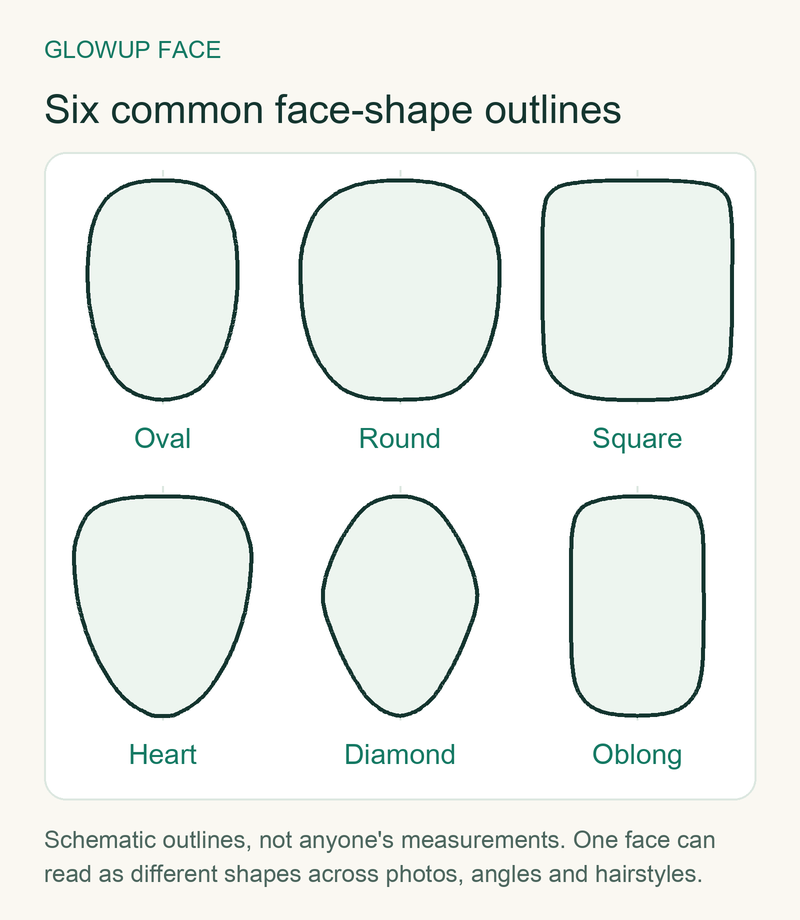
Face-shape names are styling shorthand for a visible outline. Different editors may emphasize different cues. Smooth jaw corners and a broad cheek impression pull a label toward round. A more tapered chin and open forehead pull it toward heart. Extra visible length with a gentle taper can read as oval.
Those cues compete in Kerr’s public photos. Her cheek area often reads as broad, while the jaw corners look smooth and the chin looks softly tapered. Her face can appear more width-led in a close, smiling frame. It can read as more length-led in a straight, relaxed frame. Hair placement can hide the forehead or jaw edge.
Danielle Fontana Dooley’s 2024 NewBeauty guide and Courtney Higgs’s 2019 Who What Wear guide place Kerr among round examples. Get the Gloss also uses her as its round example in a 2015 guide based on Northwood’s advice. Katherine J. Igoe’s 2024 Marie Claire list groups her with heart-shaped styles. Lian Chan’s 2024 brow guide calls her oval.
None of those pages gives a formal classification method. They are editorial styling labels, not independent measurements. That is why one source cannot settle the question for every photo. For the bigger idea, read why face-shape labels overlap.
What changes from one photo to the next
Camera distance and lens
Camera distance changes perspective. A close camera makes the nearest areas occupy more of the frame. It can also change how broad the forehead, cheeks and jaw appear against each other.
Lens choice is mostly tied to framing. A wide lens often leads the photographer to move closer to fill the frame. A longer lens allows a farther viewpoint for the same crop. Cropping later does not undo perspective created when the photo was taken.
Adeeb Derakhshan and colleagues photographed twelve adults under controlled camera setups for a 2024 Laryngoscope study. Close phone portraits changed visible facial proportions against their farther camera reference. The sample was small, so it supports a camera warning rather than a label for one person. A close portrait cannot settle Kerr’s category.
If your own selfies keep changing the answer, compare how selfie distance changes the visible outline before choosing a style.
Head angle and expression
A head turn hides part of the far jaw and shifts the visible cheek outline. Tilting up or down changes how the chin, jaw corners and forehead stack in a flat image. Mezentseva and colleagues compared frontal photos from 148 Buryat and 155 Russian participants in Annals of Human Biology in 2025. Head position changed projected facial shape, especially in the Buryat group. The result supports caution about pose; it does not classify a public figure.
Expression moves the soft outline as well. A smile lifts the cheeks and changes the mouth, eye area and lower-face impression. Farnell and colleagues analyzed still photos from eighty Finnish adults and dynamic scans from sixty British adults. Their 2018 Journal of Imaging study found that neutral and smiling expressions produced different shape patterns.
That is why Kerr’s smiling and neutral frames need not produce the same styling label. The guide on what a smile changes in face-shape photos explains how to compare like with like.
Hair and the photo’s year
Hair changes the border a viewer sees. Hair tucked behind the ears exposes the cheek and jaw outline. Side volume can make the face read broader. A center part adds a strong vertical line. Bangs can hide part of the forehead, while a swept side can change the balance between both sides.
The year attached to a photo matters as provenance, not as an explanation by itself. Photos from different years may come from different campaigns, cameras, crops, editing standards, haircuts and parts. Check the original publication and styling before treating two frames as contradictory. Do not assume the year caused the label.
Which outline reading fits most often?
Round is the most repeated label among the style pages opened for this article. It fits when the cheek area looks broad, the jaw corners read as smooth and visible face length does not dominate width. Heart becomes plausible when the forehead reads more open and the chin looks more tapered. Oval becomes plausible when the sides are less exposed and the vertical outline leads.
Across the cited public-photo guides, the forehead impression changes with how much hair is moved away. The cheekbone-width impression often looks fuller than the jaw-width impression, but the difference is not always strong. Face length against width can read balanced or more length-led. Jaw corners usually look smooth and the chin softly tapered.
Round with a soft taper is a more honest description than a fixed box. Round-heart can also be useful when a photo shows both broad cheeks and a narrowing chin. The label should describe the frame you are styling from, not overrule what you can see.
Borrow the styling effect, not the label
Choose the effect first: more vertical flow, more fullness near the jaw or a softer border around the forehead. Then account for your hair texture, density, natural brow growth and frame fit. A face-shape category should narrow options, not dictate one look.
| Outline feature | Why it can read differently between photos | Styling option to try |
|---|---|---|
| Broad cheek impression with smooth jaw corners | A close camera, a smile or hair tucked behind the ears can make the cheeks more prominent. | Try longer face-framing layers and keep the fullest hair above or below cheek level. Compare a center part with a side part. |
| Open forehead with a softly tapered chin | A clear hairline makes the upper outline visible, while bangs can hide it and shift the label. | Try side-swept bangs or curtain bangs with some movement near the jaw. |
| Face looks more length-led than width-led | A farther camera, lower side volume and a center part can strengthen the vertical impression. | Try a collarbone cut or a side part with gentle fullness at the sides. |
| Rounded jaw corner and soft chin outline | A head turn hides the far jaw, while directional light can sharpen the nearer edge. | Try softly angular acetate frames or a brow with a gentle rise. Let bridge and temple fit decide the frame. |
This table is an illustrative editorial mapping, not a test. It links a visible feature with a common photo variable and a reversible styling option. It contains no measurements of Kerr or anyone else, and it is not a claimed product result. Pick the row that matches your own outline; the rows are options, not a sequence.
Because round is the most repeated label in the reviewed sources, the women’s round-face hairstyle guide is the closest single hub. Use it as a menu. Borrow heart or oval ideas when your own outline shares those cues.
Check your own outline once
Use the on-device face-shape finder with a clear, front-facing photo and a relaxed expression. Keep your full outline visible and place the camera farther back. The tool estimates a visible styling category in your browser. It cannot reveal bone anatomy or choose a mandatory haircut.
If the suggested label shifts between good photos, do not chase a final verdict. Choose the styling option that serves your goal. Frames still need to fit, brows should follow their natural growth and a haircut must work with your texture and routine.

Oscar Nascimento
Editorial writer, GlowUp Face
Oscar writes about evidence-based skin care, healthcare, looksmaxxing, and the social and economic research surrounding appearance.
Full profile and all articles →


