
The mouth to nose ratio compares horizontal mouth width with horizontal nose width in a straight-on photo. It can be written in either direction. Mouth divided by nose tells you how many nose-widths fit across the mouth. Nose divided by mouth reports the same relationship as its reciprocal. It is a unitless photo estimate, not an attractiveness score or clinical measurement.
Formula: mouth-to-nose ratio = mouth width ÷ nose width. Mouth width is the pixel distance from cheilion to cheilion, the two mouth corners at rest. Nose width is the pixel distance from alare to alare, the outer edges of the nostril wings. Nose-to-mouth ratio = nose width ÷ mouth width = 1 ÷ mouth-to-nose ratio. Both inputs come from one photo. The result has no unit and is never millimetres.
Mouth to nose ratio landmarks
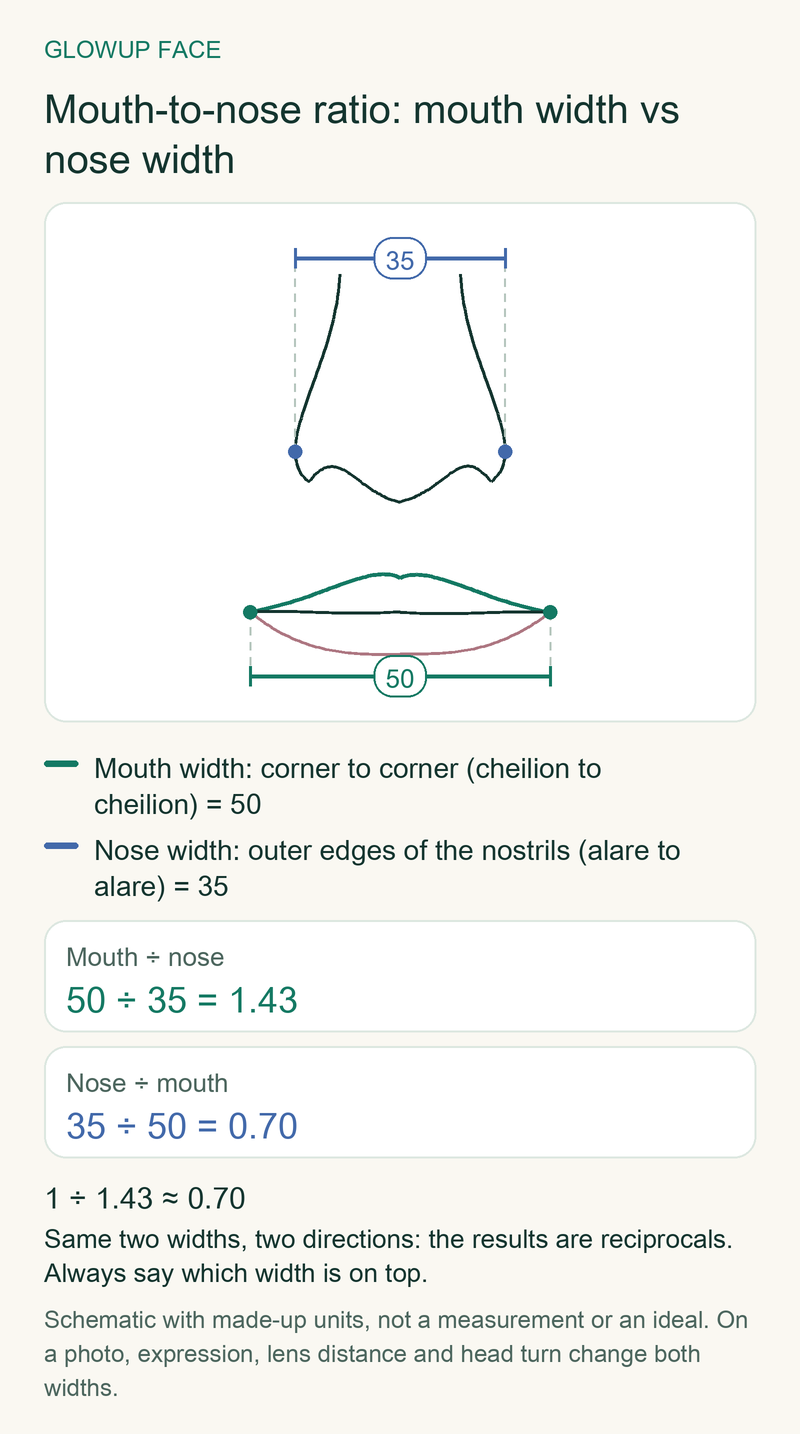
Cheilion, shortened to ch, is each labial commissure: the point where the upper and lower lips meet at a mouth corner. Use the corners with the lips relaxed and closed. A smile pulls these soft-tissue points outward.
Alare, shortened to al, is the most lateral point on each alar contour. In plain terms, mark the outermost edge of each nostril wing in the front view. Katina and colleagues defined both landmarks this way in the Journal of Anatomy in 2016. Their work also shows why orientation-based landmark placement can vary between observers.
Names differ across papers. Mouth breadth and labial-fissure width often mean ch-to-ch. Nasal width and alar width often mean al-to-al. Alar curvature points, labelled ac, sit in the crease where the nasal wing meets the cheek. They aren't the same endpoints. Record the abbreviations before comparing results.
How to measure both directions from a photo
- Use one clear front photo. Keep your head level, face the camera, and relax your closed lips. Avoid a wide-angle selfie taken close to your face.
- Mark the left and right cheilion points. Then mark the left and right alare points.
- Measure each horizontal span in pixels. Use right x-coordinate minus left x-coordinate, with the same image and method for both widths.
- Divide mouth width by nose width. Then divide nose width by mouth width, or take 1 ÷ the first ratio.
You don't need to convert pixels into millimetres because both widths share the same image scale. Enlarging the whole photo equally leaves the ratio unchanged. That does not cancel perspective error. Healy and Stephan explained in a 2023 facial-photography study that camera-to-face distance sets perspective. A small head turn can also foreshorten one side and shift the apparent endpoints.
Worked example: the same numbers in both directions
Suppose the mouth spans 50 pixels and the nose spans 35 pixels. Mouth ÷ nose is 50 ÷ 35 = 1.43. Nose ÷ mouth is 35 ÷ 50 = 0.70. The second result is the reciprocal: 1 ÷ 1.43 ≈ 0.70. These are illustrative numbers, not a target.
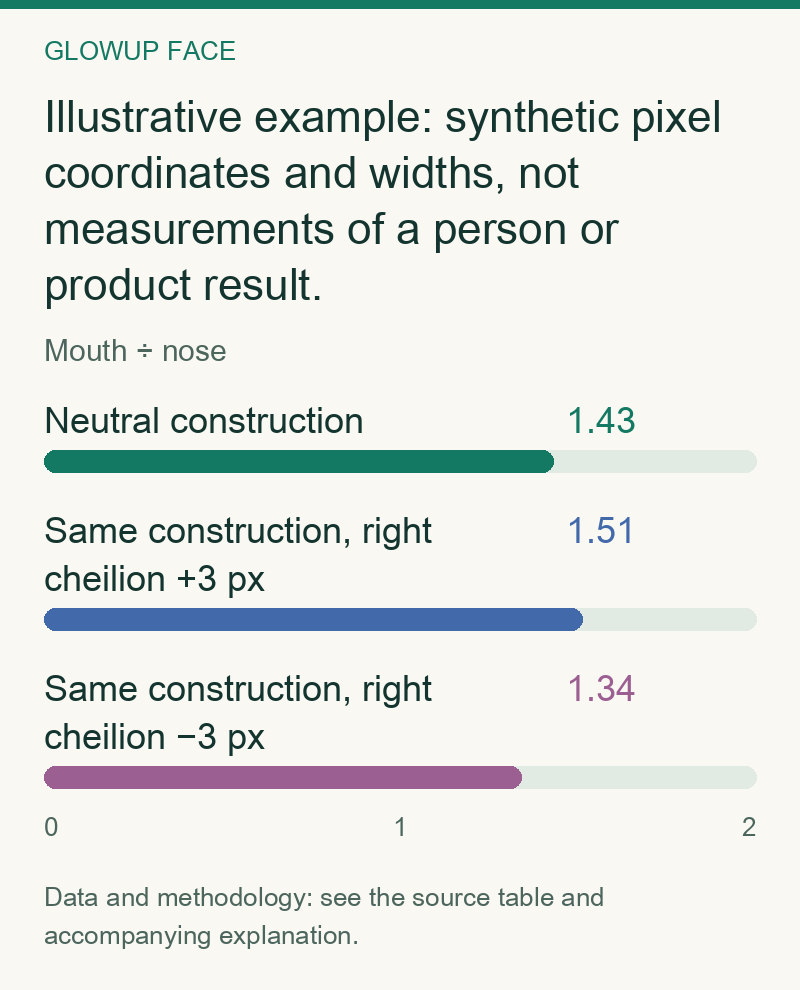
| Illustrative state | Left cheilion x | Right cheilion x | Mouth width, ch–ch | Left alare x | Right alare x | Nose width, al–al | Mouth ÷ nose | Nose ÷ mouth |
|---|---|---|---|---|---|---|---|---|
| Neutral construction | 20 px | 70 px | 50 px | 28 px | 63 px | 35 px | 1.43 | 0.70 |
| Same construction, right cheilion +3 px | 20 px | 73 px | 53 px | 28 px | 63 px | 35 px | 1.51 | 0.66 |
| Same construction, right cheilion −3 px | 20 px | 67 px | 47 px | 28 px | 63 px | 35 px | 1.34 | 0.74 |
The first row matches the worked example. In the second row, only the right mouth corner moves three pixels outward. Using unrounded values, mouth ÷ nose rises by 0.086. The displayed value moves from 1.43 to 1.51. Its reciprocal falls from 0.70 to 0.66.
The third row moves that corner three pixels inward instead. Mouth ÷ nose falls by 0.086, from 1.43 to 1.34 after rounding. Nose ÷ mouth rises from 0.70 to 0.74. This is an arithmetic sensitivity check, not an estimate of landmarking error in real photos.
Expression can cause a much larger real change. Sawyer, See and Nduka tracked 71 volunteers with 3D imaging in 2010. From rest to a maximum smile, each cheilion moved an average 16.6 mm through three dimensions. That study doesn't predict your pixel change. It shows why relaxed and smiling photos shouldn't be compared.
Nose width can move too. Beiraghi-Toosi, Rezaei and Zanjani compared rest and maximum-smile photos in 50 adults in 2016. Alar-base diameter increased in 46 cases, while maximum alar flaring increased in 48. The sample was small and 90% female, so it doesn't set a general amount.
What does the number tell you?
A mouth-to-nose result above 1 means the mouth appears wider than the nose in that photo. A result below 1 means the nose appears wider. A result of 1 means the two measured spans are equal. The reverse ratio flips those descriptions, so always label the direction.
The ratio doesn't measure lip fullness, nose projection, nostril shape, symmetry, or face shape. It also doesn't explain whether a feature looks prominent within the whole face. If you want broader context, our guide to facial fifths and horizontal proportions explains a different set of comparisons.
Keep raw width, ratio, and angle separate. Fifty pixels is a raw distance. 1.43 is a unitless ratio. An angle is measured in degrees. None can be substituted for another.
Is there an ideal value?
No universal ideal has been established. The often-repeated 1.5 mouth-to-nose figure comes from a neoclassical canon, not a biological target. Its reciprocal is 1 ÷ 1.5 = 0.67. Farkas, Hreczko, Kolar and Munro tested nine such canons in 1985. Their young-adult sample comprised 153 participants the paper classified as North American Caucasians. They found large normal variation and warned that the canons didn't represent average facial proportions.
Borman, Özgür and Gürsu directly measured 1,050 young Turkish adults in 1999. Only 6% of women and 5% of men had mouth width equal to 1.5 times nose width. Mouth width was greater than that canon for 53% of women and 54% of men. It was lower for 41% in each group. Those percentages describe that sample, not an attractiveness scale.
Fang, Clapham and Chung reviewed 2,359 people from 27 ethnic groups in 2011. Nose and mouth dimensions varied across groups, with nasal width among the most variable measures. Their broad study labels don't predict any individual's face. A population average still isn't a personal target.
What can make the photo ratio change?
- Expression: smiling moves the mouth corners and may widen the visible nasal base.
- Camera distance: close photos exaggerate depth differences. Keep distance and camera position consistent for comparisons.
- Head turn: yaw foreshortens the farther side and can hide the true outer contour.
- Head roll: a tilted face makes horizontal endpoints harder to mark consistently.
- Landmark choice: alare and alar-curvature points are different, even when a diagram makes them look close.
- Image quality: blur, shadows, makeup, facial hair, and filters can obscure a corner or edge.
Lim, Abdul Shakor and Shaharudin compared ten 2D facial dimensions with direct measurements in 96 Malaysian adults in 2022. Seven met their accuracy criterion, while three did not. They did not validate this exact ratio. Their result is a reason to treat unvalidated photo measurements as estimates.
A 2D photo estimate reflects soft tissue, camera distance, head pose, and expression. It cannot measure bone or provide clinical values. For more on that boundary, read what photo-based proportion analysis can and cannot measure.
Use the ratio as a description, not a correction
You don't need to change a normal feature because a number misses an old canon. If you want a different photo effect, styling can change context without claiming to alter anatomy. Lip liner can shift the visible mouth edge slightly. Glasses, facial hair, and haircut framing can draw attention across different widths.
These are choices, not fixes. A haircut shouldn't be prescribed from this ratio alone. If nose framing is your actual question, this haircut guide explains practical framing options without treating nose size as a defect.
One useful next step
If your goal is choosing hair framing, use the on-device face-shape finder to estimate your visible outline. It doesn't output the mouth-to-nose ratio, measure bone, or choose a mandatory haircut.

Oscar Nascimento
Editorial writer, GlowUp Face
Oscar writes about evidence-based skin care, healthcare, looksmaxxing, and the social and economic research surrounding appearance.
Full profile and all articles →


