

A long philtrum means the skin between the nose base and upper lip border measures longer than the reference being used. A short philtrum measures shorter. Neither label is a diagnosis or a universal beauty score. Use the correct landmarks, compare like with like, and never convert an uncalibrated photo into millimeters.
Long philtrum vs short philtrum: what changes
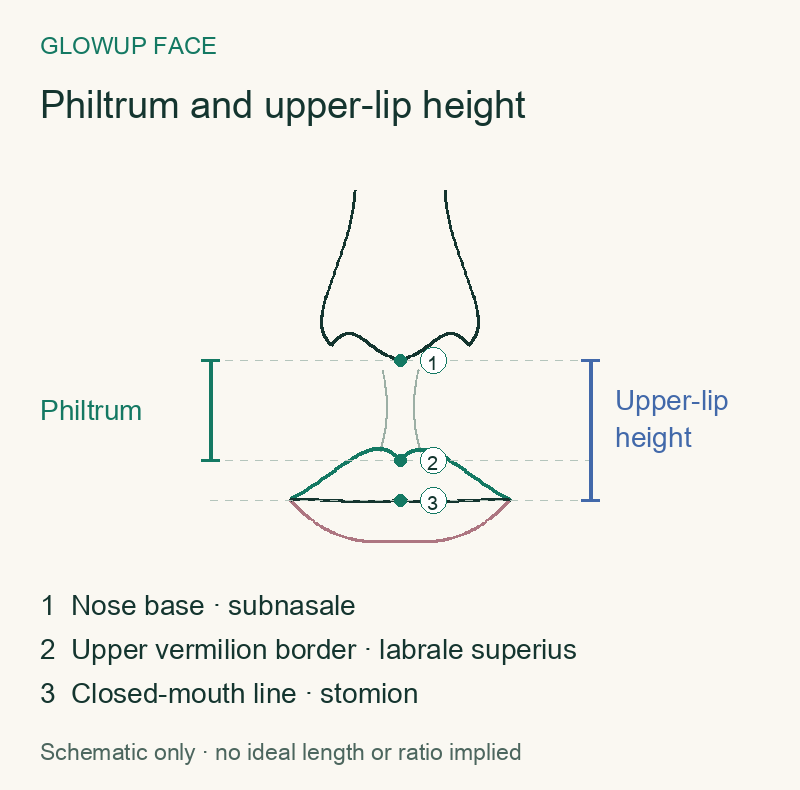
The key distance runs from subnasale to labiale superius. That is the skin-only part above the red upper lip. It is not the whole height from your nose to the line where your lips meet.
| Observation | What it describes | Useful next check | What it cannot establish |
|---|---|---|---|
| Longer philtrum | A longer nose-base-to-vermilion distance within the stated reference | Confirm the landmarks and repeat the same photo setup | Attractiveness, health, personality, or a need for treatment |
| Shorter philtrum | A shorter nose-base-to-vermilion distance within the stated reference | Keep total upper-lip height separate from the skin segment | Youth, femininity, or an ideal proportion |
| Uncertain from photos | The apparent length changes with distance, tilt, expression, or lip-border makeup | Retake three neutral photos from a fixed position | That your anatomy changed |
Use three landmarks, not one vague line
Hasibuan, Prasetyo, and Pramono used these distances in a 2024 JPRAS Open study. They photographed 100 Indonesian adults aged 20 to 35. The study used seven lip landmarks, but three answer this question.
- Subnasale, or sn: the central point where the nose base meets the upper-lip skin.
- Labiale superius, or ls: the midpoint of the upper vermilion border at the Cupid's bow.
- Stomion, or st: the midpoint of the line where the lips meet at rest.
Philtrum length is sn to ls. Upper-vermilion height is ls to st. Total upper-lip height is sn to st. On one frontal 2D image, the vertical pixel spans add together when you use one scale and consistent landmarks.
A common error is calling sn to st the philtrum. That line includes the red lip. Another is placing ls on lipstick rather than the natural vermilion border. Either mistake can reverse a long-versus-short comparison.
There is no universal ideal length
Zankl and colleagues measured 2,500 healthy Central European people from birth to age 97. Their 2002 American Journal of Medical Genetics paper produced age-specific growth charts. It was a clinical reference for dysmorphology, not an attractiveness scale.
The 2024 Indonesian study also found sex differences in sn-to-ls length. Its authors warned against applying one population's standards to another. That sample was small, young, and population-specific, so it cannot supply a global cutoff.
Age changes the context too. Iblher and colleagues studied 182 standardized photographs in 2008. They also compared MRI scans from 30 women aged 20 to 35 with scans from 30 women aged 65 to 80.
Both parts found statistically significant upper-lip lengthening with age. That is a group finding, not a prediction for one face.
Use “long” or “short” only against a named reference with the same age range, population, landmarks, and method. Otherwise, it is a visual impression.
Methods that must stay separate
| Method | What is recorded | Valid unit | Fair comparison | Main limit |
|---|---|---|---|---|
| Direct anthropometry | Landmarks placed on the person | Millimeters | Same technique and a relevant reference sample | Landmark placement and soft-tissue pressure |
| Calibrated 3D imaging | Landmarks on a three-dimensional facial surface | Millimeters | Same calibrated device and measurement protocol | Calibration, reconstruction, and landmark error |
| Uncalibrated 2D photo | A projected distance on one image | Pixels or within-image percentage | Repeated photos with the same camera, lens, distance, and pose | No valid conversion to real-world millimeters |
Sforza and colleagues compared computerized measurements from 705 Northern Italians with conventional reference datasets in 2004. The datasets were not identical. Average cutaneous upper-lip heights differed by up to 2.9 millimeters from one European reference set.
The authors still considered the methods close enough for many clinical uses. But method and population changed together, so their difference is not a conversion formula. If you are debating a few millimeters, label the method and do not merge its result with another method.
Illustrative landmark example
The coordinates below are synthetic and illustrative. They are not measurements from a person, patient, customer, or product. They show the arithmetic and the uncertainty created by repeating a photo.
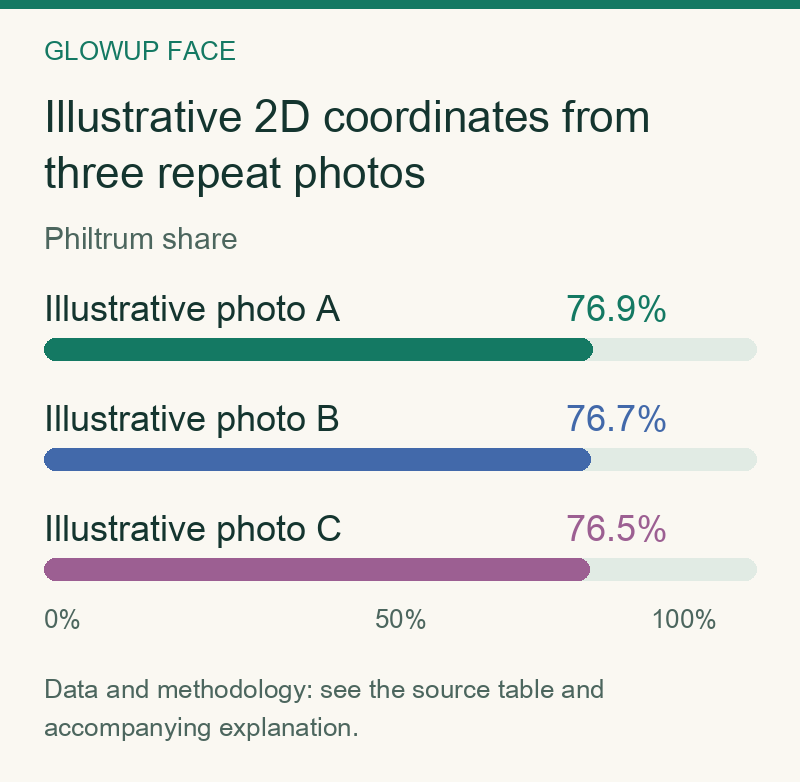
| Image | sn coordinate | ls coordinate | st coordinate | Philtrum, sn to ls | Vermilion, ls to st | Total, sn to st | Philtrum share |
|---|---|---|---|---|---|---|---|
| Illustrative photo A | 210 pixels | 330 pixels | 366 pixels | 120 pixels | 36 pixels | 156 pixels | 76.9% |
| Illustrative photo B | 218 pixels | 340 pixels | 377 pixels | 122 pixels | 37 pixels | 159 pixels | 76.7% |
| Illustrative photo C | 205 pixels | 322 pixels | 358 pixels | 117 pixels | 36 pixels | 153 pixels | 76.5% |
For each row, subtract sn from ls for the philtrum. Subtract ls from st for the upper vermilion. Subtract sn from st for total upper-lip height. Divide the first result by the total to get the within-image percentage.
The illustrative philtrum spans 117 to 122 pixels, a five-pixel spread. The percentage spans 76.5% to 76.9%. That spread represents repeat-photo and landmark uncertainty.
It does not mean the anatomy moved. The percentage is not a beauty target, and it cannot be converted into millimeters.

A careful home photo check
This is an editorial comparison method, not a validated medical protocol. Its purpose is to catch obvious photo errors before you interpret a result.
- Place the camera about five feet away, centered on the midface. Use the same rear-camera lens each time.
- Keep your head level and face forward. Rest your lips together without smiling, pressing, or opening them.
- Take three photos without moving the camera. Do not cover the natural upper-lip border with liner.
- Mark sn, ls, and st. Record vertical pixel differences and the within-image percentage only.
- If the three results disagree, fix the capture setup. Do not average poor photos into a precise-looking answer.
Camera distance matters. Derakhshan and colleagues photographed 12 people for a 2024 Laryngoscope study. At eight inches, smartphone images stretched measured midfacial features vertically by 18%.
At 12 inches, the increase was 12%. The reference was a full-frame camera at 60 inches.
That small study did not validate philtrum measurement itself. It did show that close selfie distance can change vertical facial proportions enough to mislead you. Head tilt and a moving lip border add more uncertainty.
What should you do with the result?
If repeat photos disagree, your next step is a better photo, not a conclusion about your face. If the result is stable, describe it as a 2D proportion under that setup. Our guide to what AI can measure from a face photo explains why visible landmarks still do not reveal bone anatomy or clinical measurements.
If your goal is visual balance rather than measurement, keep the response reversible. Lip-border makeup can change where viewers read the border without changing the philtrum. The upper-lip makeup guide shows that styling route. A measurement alone is not a reason to seek a procedure.
Two quick answers
Is 15 millimeters considered long?
Not by itself. First confirm that the number is sn to ls, not sn to st. Then check the person's age, reference population, and measurement method. A 2D uncalibrated photo cannot supply that millimeter value.
Does smiling change the measurement?
It changes the visible landmark positions in a photo because the upper lip moves. Use a neutral face for a static comparison. A smile image answers a different question about movement.

Oscar Nascimento
Editorial writer, GlowUp Face
Oscar writes about evidence-based skin care, healthcare, looksmaxxing, and the social and economic research surrounding appearance.
Full profile and all articles →


