

Canthal tilt is the angle of a line from the inner corner of your eye to the outer corner, read from nose to temple. The tilt is positive when the outer corner sits higher, neutral when both corners look level, and negative when the outer corner sits lower. You can estimate it from a front-facing photo. But head position and image rotation can change the result without changing your anatomy.
Positive, neutral and negative canthal tilt
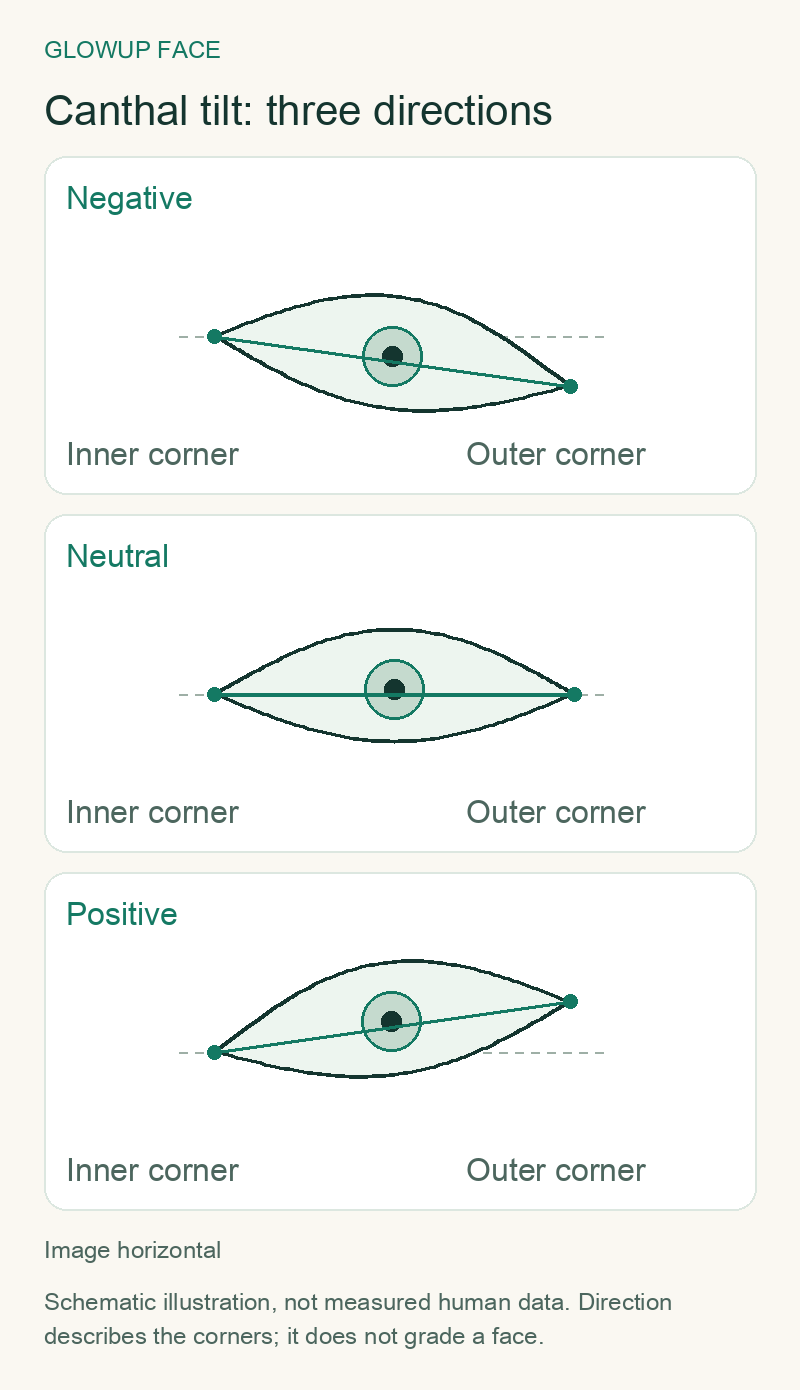
The medial canthus is the inner meeting point of the eyelids, beside the nose. The lateral canthus is the outer meeting point, toward the temple. Canthal tilt compares the line between those two landmarks with a chosen horizontal reference.
| Label | Outer corner position | Signed angle | What the label describes | What it does not establish |
|---|---|---|---|---|
| Positive | Higher than the inner corner | More than 0° | The line rises toward the temple | A better eye shape, personality, or health |
| Neutral | About level with the inner corner | About 0° | The line is horizontal within marking error | An exact biological category |
| Negative | Lower than the inner corner | Less than 0° | The line falls toward the temple | A diagnosis, tiredness, or lower worth |
These signs assume the vertical coordinate increases upward. Most image software counts pixels downward from the top edge, so its raw sign is reversed. Check the coordinate convention before comparing results.
Measure each eye separately. A single value made from all four corners can hide ordinary left-to-right differences. It can also conceal a bad landmark on one side.
There is no universal ideal angle. Packiriswamy, Kumar and Rao reported a 2012 study in the North American Journal of Medical Sciences. They measured standardized photographs of 300 Malaysian South Indian adults aged 18 to 26. Mean palpebral-fissure inclinations were 4.72° for men and 7.04° for women. Those values describe that sample, not a target for every face or population.
How to measure the angle from a photo
This home check is an editorial method for comparing photographs. It is not a validated clinical test.
- Take a front-facing photo with the camera at eye level. Keep your head upright, gaze forward, and expression relaxed.
- Level the file with an independent camera guide or a vertical reference in the scene. Do not level it from the eye corners, because that erases the feature you want to measure.
- Define local x from nose to temple and local y upward. Mirror one eye crop if needed, so both eyes follow that convention.
- Mark the medial and lateral canthus of one eye. Use the point where the eyelid margins meet, not the iris edge or the visible end of red tear-duct tissue.
- Record both coordinates. Calculate
atan2(y outer - y inner, x outer - x inner) × 180 / π. - Repeat for the other eye and a second matched photo. If the direction changes, call the estimate unstable instead of averaging away the error.
Controlled photography matters. Guo and colleagues published a 2020 comparison in Dermatologic Surgery. They compared direct, 2D, and 3D periocular measurements. The paper classified all 46 participants as Caucasian. For 2D measures, intraclass correlation scores were 0.99 within raters and 0.98 between raters. That shows repeatability within their protocol. It does not validate a casual selfie, a specific app, or anatomical accuracy from one image.
Worked example: rotating the image changes the answer
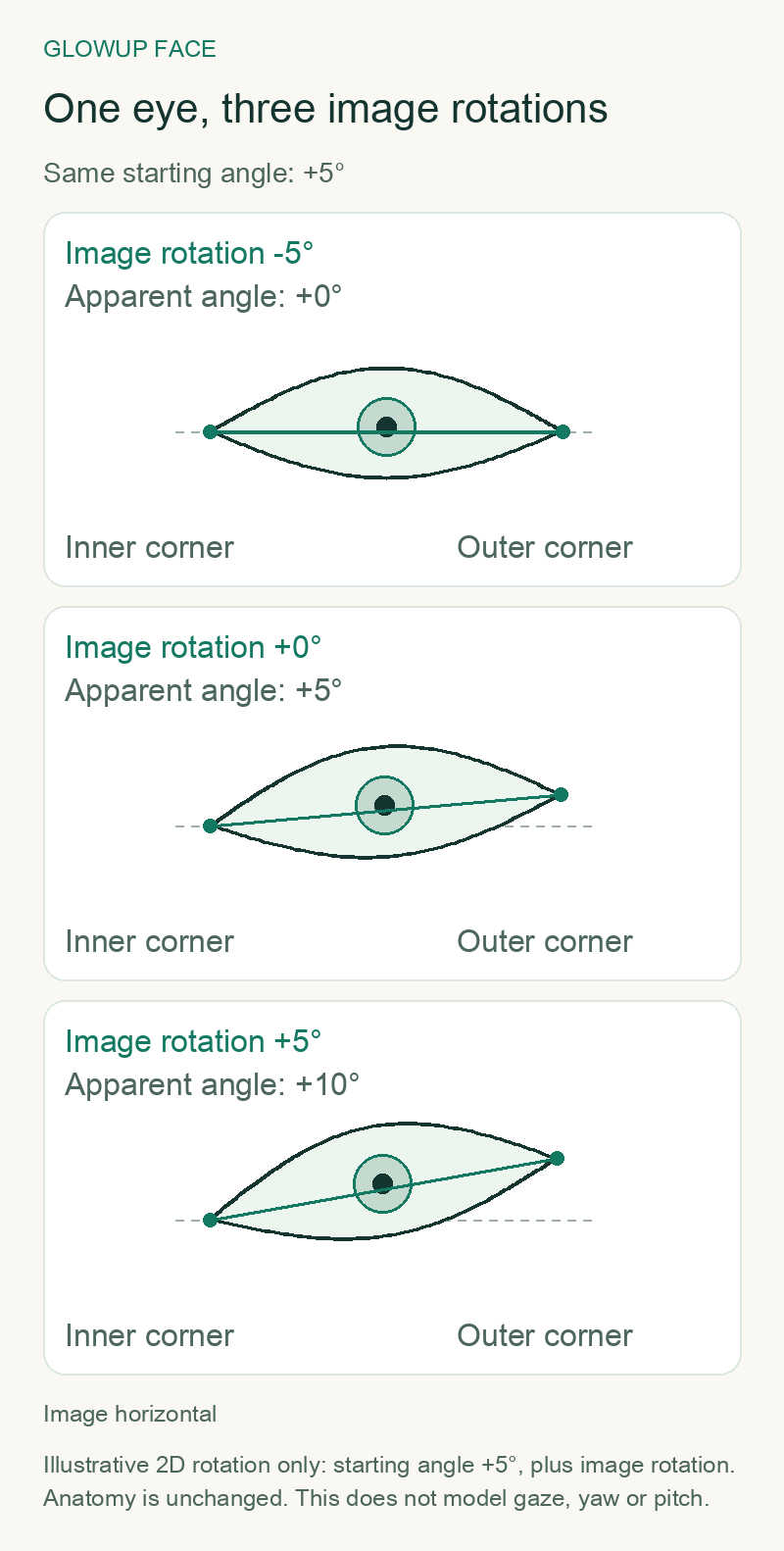
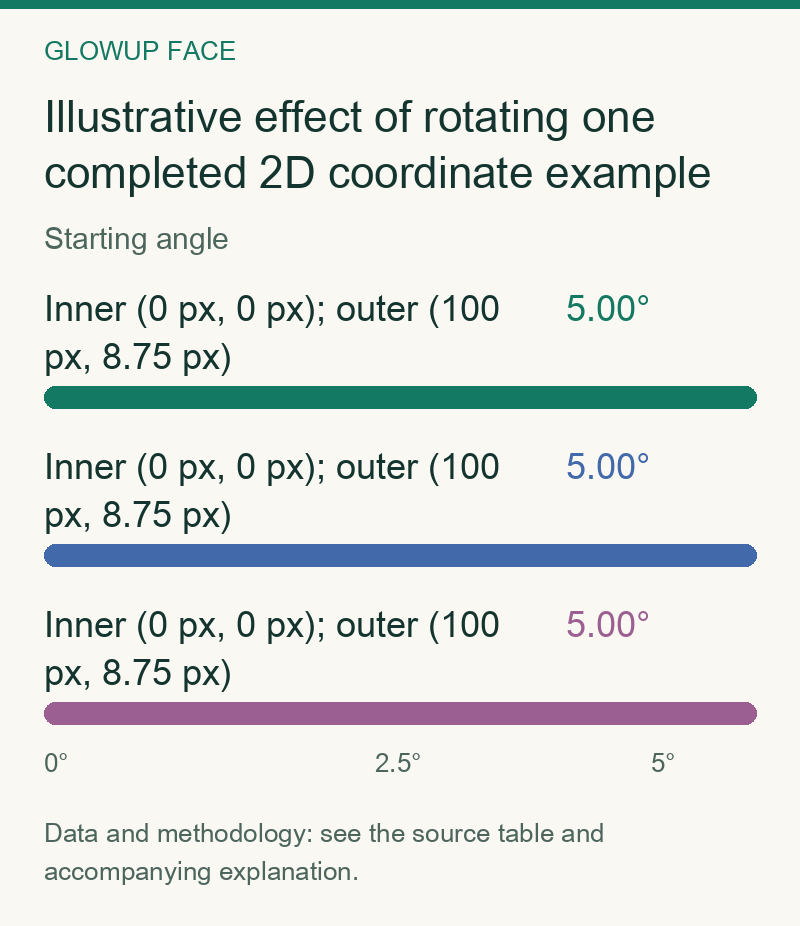
Illustrative coordinate experiment. These are synthetic points, not measurements from a person or product. Set the inner corner at (0 pixels, 0 pixels) and the outer corner at (100 pixels, 8.75 pixels). Here x runs toward the temple and y runs upward. The starting angle is atan2(8.75, 100) = 5.00°. Positive rotation means counterclockwise rotation in this coordinate system.
| Whole-image rotation | Input coordinates before rotation | Starting angle | Apparent angle against screen horizontal | Anatomy changed? |
|---|---|---|---|---|
| -5° | Inner (0 px, 0 px); outer (100 px, 8.75 px) | 5.00° | About 0.00° | No |
| 0° | Inner (0 px, 0 px); outer (100 px, 8.75 px) | 5.00° | About 5.00° | No |
| +5° | Inner (0 px, 0 px); outer (100 px, 8.75 px) | 5.00° | About 10.00° | No |
The method adds the whole-image rotation to the line's starting angle. It isolates one simple source of error: 2D roll. It is not measured human data, a gaze model, or a model of head yaw, head pitch, lens distortion, or 3D anatomy. Real corner placement also carries uncertainty.

Why two photos can give different angles
Image roll is only the cleanest case. A tilted camera or an auto-straightened crop can add or subtract degrees. Head pitch changes how three-dimensional landmarks project onto the photograph. Head yaw can change the projected distance between points that sit at different depths.
Vaca and colleagues reported a 2022 study in Aesthetic Surgery Journal Open Forum. They photographed 12 women, covering 24 eyes, with controlled head positions from -15° to +15°. The mean vertical gap between the inner and outer corners ranged from 0.128 mm to 4.39 mm. The camera stayed at eye level, while the head pitch changed. The sample included only women aged 22 to 36, so it cannot supply a universal correction. It does show that a different angle in a photo need not mean changed anatomy.
Gaze and expression create another problem. Looking sideways does not move the canthal attachments, but squinting or turning can make the eyelid meeting points harder to mark. Makeup, lashes, shadow, blur, and hair can cover the exact corner.
For progress photos, keep the camera, crop, distance, head pose, gaze, and expression as similar as you can. The guide to measuring facial proportions from a photo explains why repeatable pixels are not the same as verified anatomy.
Can the angle tell you which eyes look better?
No single angle can answer that. Sforza and colleagues published their comparison in The Angle Orthodontist in 2015. They studied 199 young Italian adults and 126 people selected through beauty competitions. The selected group had greater eye-fissure inclination on average. But selection by beauty competitions is not a universal preference test. The study also cannot show that tilt caused the selections.
Positive and negative are mathematical directions, not ratings. Canthal tilt says nothing about character, confidence, or personal value. It is one small feature within the whole eye area. If you are trying to decode internet labels, the guide to what “hunter eyes” means separates the slang from measurable features.
What a face scan can and cannot report
A face scan can place 2D landmarks and estimate the line visible in that upload. It cannot recover the true three-dimensional corner positions from one front photo. It also cannot remove every pose, gaze, lighting, or landmark error after capture.
GlowUp Face treats facial-harmony measurements as photo-based estimates, not clinical grades or beauty standards. The sample report shows the report format before you decide whether that context is useful. Any reported angle still describes the supplied image and its capture conditions.
Your useful next step is simple: make two matched, independently leveled photos and calculate each eye separately. If the direction stays the same, keep it as a photo descriptor. If it flips, improve the setup rather than assigning yourself a category.

Oscar Nascimento
Editorial writer, GlowUp Face
Oscar writes about evidence-based skin care, healthcare, looksmaxxing, and the social and economic research surrounding appearance.
Full profile and all articles →


