
What bigonial width measures
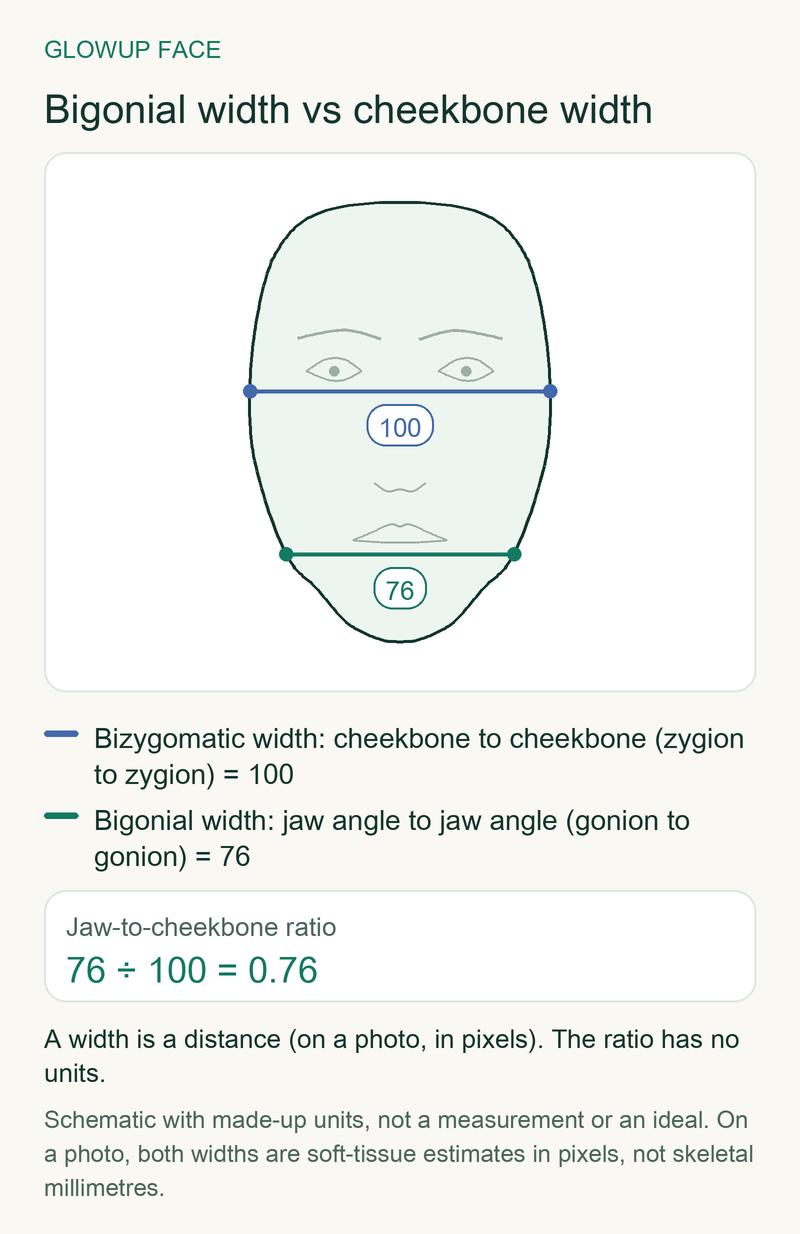
Bigonial width is the straight-line distance between the left and right gonion, the two lower-jaw angle landmarks. It is a raw width, not a ratio. An uncalibrated photo gives that width in pixels or relative units, never millimeters. Millimeter values need a calibrated clinical photo, a scaled 3D capture or direct caliper measurement.
Formula: bigonial width = distance from left gonion to right gonion. Bizygomatic width = distance from left zygion to right zygion. Gonion means the jaw-angle point, while zygion means the outer cheekbone point. The jaw-to-cheekbone ratio = bigonial width ÷ bizygomatic width. Its reciprocal is bizygomatic width ÷ bigonial width = 1 ÷ the jaw-to-cheekbone ratio.
Using the same illustrative numbers, 76 ÷ 100 = 0.76. In the other direction, 100 ÷ 76 = 1.32 after rounding. A width has units. Both ratios are unitless.
Where the four landmarks sit
Gonion, shortened to go, is the most outward point at each mandibular angle. In plain terms, it is the rear jaw corner where the upright ramus turns into the lower jaw body. Zygion, or zy, is the most lateral point on each zygomatic arch. That is the widest cheekbone point.
Source conventions differ with the method. Traditional anthropometry locates the bony gonion by touch and uses spreading calipers. Allanson and colleagues described that direct method in their 2009 standard terminology. A 3D surface scan marks a point on the facial surface. A front photo can only estimate the corresponding point on the visible outline.
Caple and Stephan made this distinction explicit in their 2016 landmark nomenclature. They explained that some 3D or touch-based landmarks become inferred “quasi-landmarks” in a photograph. Calling each point gonion does not make the methods interchangeable.
Keep width, ratio and angle separate
- Raw bigonial width: gonion to gonion, recorded as a distance.
- Raw bizygomatic width: zygion to zygion, also recorded as a distance.
- Jaw-to-cheekbone ratio: bigonial width divided by bizygomatic width, with no units.
- Gonial angle: an angle at the jaw corner, recorded in degrees. It is not jaw width.
A face can have a large raw jaw width and still have a modest ratio if its cheekbone width is also large. The inverse ratio describes the same relationship in the opposite direction. If you are comparing this with a vertical face measure, our facial width-to-height ratio guide keeps those formulas separate. For the corner angle itself, use the gonial angle guide.
Why a photo is only an estimate
A 2D photo estimate reflects soft tissue, lens distance, head pose and expression. It cannot measure bone or produce clinical values.
Lim, Abdul Shakor and Shaharudin compared direct measurements with 2D photographs in 96 Malaysian adults in 2022. Bigonial and bizygomatic breadth showed meaningful disagreement between methods. Bigonial breadth also had low inter-rater reliability. That result applies to their setup, but it shows why a selfie should not be labelled a skeletal measurement.
Moreton and Morley photographed 25 people at different camera angles in a controlled 2011 study. For some facial proportions, angle-driven variation within one person reached the variation seen between different people. Their forensic task differs from a styling check, yet the camera problem is the same.
For a wider explanation of these limits, see what AI can measure from a face photo.
Worked example in pixels
This example uses synthetic x-coordinates on a level front-view image. No row represents a person, customer or product result. For each width, subtract the left x-position from the right x-position. The second row doubles the image scale. The third tests a small marking error.
| Scenario | Left gonion x | Right gonion x | Left zygion x | Right zygion x | Bigonial width | Bizygomatic width | Bigonial / bizygomatic | Bizygomatic / bigonial |
|---|---|---|---|---|---|---|---|---|
| Baseline construction | 12 px | 88 px | 0 px | 100 px | 76 px | 100 px | 0.76 unitless | 1.32 unitless |
| Same construction at 2× scale | 24 px | 176 px | 0 px | 200 px | 152 px | 200 px | 0.76 unitless | 1.32 unitless |
| Each gonion marked 2 px inward | 14 px | 86 px | 0 px | 100 px | 72 px | 100 px | 0.72 unitless | 1.39 unitless |
The sensitivity row moves each gonion mark inward by 2 px. The raw jaw width falls by 4 px, from 76 px to 72 px. The jaw-to-cheekbone ratio falls by 0.04, while its rounded inverse rises by 0.07.
The scale row shows why pixel width changes with camera distance, cropping or resizing. A ratio cancels uniform scale, but it does not cancel head turn or perspective. Compare ratios only between photos taken the same way.
How to make repeat photos less misleading
- Use the same camera, lens, distance, image size and crop each time. Keep the camera at face height.
- Face the camera squarely with a level head and neutral expression. Keep your jaw relaxed rather than clenched.
- Keep hair off the cheek and jaw outlines. If your beard changes, record that before comparing the marks.
- Mark both sides without moving the image, then repeat the marks once. A 2 px shift can matter, as the table shows.
These steps improve consistency. They do not validate a home photograph as a clinical measurement.
What moves the visible jaw corners
Soft tissue changes the outline over the mandible. The masseter muscle can bulge when you clench, making the visible lower face look wider. A relaxed jaw gives a different contour without changing the bone.
A beard can extend or hide the jaw edge. Dense facial hair also makes landmark placement less repeatable. Hair beside the cheeks can obscure the zygion estimate.
Head turn creates a projected width, not a straight frontal view. One side moves nearer the camera while the other becomes foreshortened. Even a small turn can shift both the width and the ratio.
There is no universal ideal ratio
Anthropometric references describe sampled populations. They do not set beauty targets. Farkas and colleagues measured 1,470 adults aged 18 to 30 across several population groups in 2005. They found facial dimensions varied between groups and called the work preliminary because several samples were small.
Weinberg and colleagues built age- and sex-specific summaries from 2,454 US participants aged 3 to 40 in 2016. Those data support research and clinical comparison. They are not beauty cutoffs.
Neither study can tell you what your jaw “should” measure. Reference values depend on the sampled population and the measurement method. A population average is not an attractiveness standard.
Use the relationship as a styling option
The ratio can describe how strongly the visible outline narrows from cheekbones to jaw. It cannot tell you whether that outline needs correction.
- Hair: side volume near the temples or cheeks can shift visual balance upward. Sleeker sides can leave the lower-face outline more prominent.
- Beard: more bulk at the jaw corners can widen the visible contour. Shorter sides or a tapered shape can show more cheek-to-jaw narrowing.
- Glasses and brows: if you want more emphasis higher on the face, try stronger horizontal lines there. Softer lines keep the frame less dominant.
Choose the effect you prefer. None changes the underlying width, and no option is required.
One useful next step
If your real decision is about hairstyle, use the face-shape finder for the visible outline. It estimates a broad face-shape label for styling. It does not output this specific width, ratio or any skeletal measurement.

Oscar Nascimento
Editorial writer, GlowUp Face
Oscar writes about evidence-based skin care, healthcare, looksmaxxing, and the social and economic research surrounding appearance.
Full profile and all articles →


