

The nasofrontal angle is the side-profile angle at the nasion, where the forehead meets the nasal bridge. It is an angle in degrees, not a raw distance or ratio. A common three-point formula is θ = arccos[((G − N) · (Prn − N)) / (|G − N| × |Prn − N|)]. Here, G is glabella, N is nasion, and Prn is pronasale.
That formula gives a photo estimate of the visible soft-tissue contour. It does not measure bone, diagnose anything, or tell you how attractive a face is.
What the three landmarks mean
Glabella is the most forward midline point of the forehead between the eyebrows. Nasion is the deepest visible point where the forehead flows into the nasal root. Pronasale is the most forward point of the nasal tip.
Seo and colleagues used those three points in a 2022 Scientific Reports study. Their nasofrontal angle was G–N–Prn, with the vertex at N. The two rays run from nasion toward glabella and pronasale.
Other conventions use a tangent along the forehead and another along the nasal dorsum. Gautam, Sreedharan, and Seetha used that tangent method in a 2019 profile study. A curved or humped bridge makes tangent placement subjective, so numbers from different conventions aren't directly interchangeable.
The nasal root guide explains the region around nasion in more detail. The region and the angle are related, but they aren't the same measurement.
How to measure the nasofrontal angle in a photo
- Take a true side photo. Use the rear camera at nose height. Keep a neutral expression and look straight ahead.
- Step back before framing. About 1.5 metres is a practical starting point. Zoom or crop instead of placing a wide camera close to your face.
- Mark one convention. For G–N–Prn, place glabella, the deepest visible nasal-root point, and the forward nasal tip.
- Draw two rays. Draw G to N and N to Prn. Measure the inside angle at N with an angle tool or the formula above.
- Save the capture details. Record the side, camera, distance, head position, image size, and landmark convention. Use the same setup for any repeat.
A mirror selfie is a poor source because the camera is often too close and shows a three-quarter view. Mirroring can also hide which side you measured, although it does not change the angle.
Illustrative example: a two-pixel choice can matter
This example uses a synthetic 200 px by 200 px profile crop, not a measured person or a GlowUp Face result. The image origin sits at the top left, so a lower y-coordinate means a point moved upward. Each result uses the dot-product formula above.
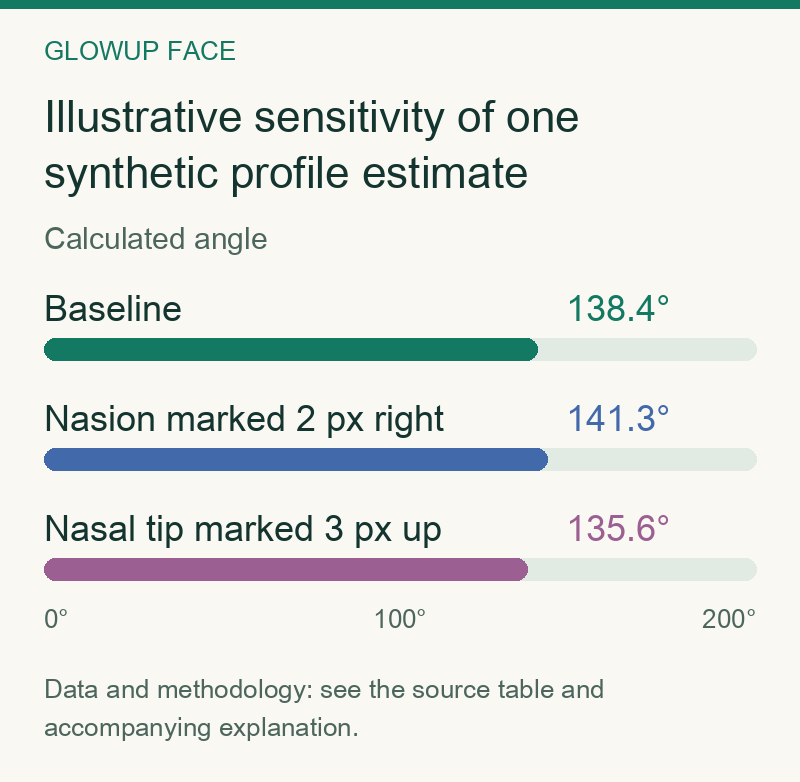
| Scenario | Glabella coordinate | Nasion coordinate | Pronasale coordinate | Calculated angle | Change from baseline |
|---|---|---|---|---|---|
| Baseline | (80 px, 50 px) | (100 px, 100 px) | (150 px, 125 px) | 138.4° | 0.0° |
| Nasion marked 2 px right | (80 px, 50 px) | (102 px, 100 px) | (150 px, 125 px) | 141.3° | +2.9° |
| Nasal tip marked 3 px up | (80 px, 50 px) | (100 px, 100 px) | (150 px, 122 px) | 135.6° | −2.8° |
The face did not change between rows; only one synthetic mark moved. The result shows why decimal precision can overstate what a home photo supports. A larger, sharper image may reduce pixel error, but it cannot remove landmark judgment.
Campomanes-Álvarez and colleagues tested facial landmark placement by 39 operators across ten photographs in 2015. Glabella and nasion were among the points most often located, yet the study still found observer dispersion. Finding a point often is not the same as placing it identically.

How pose and camera distance move the estimate
Simple image tilt does not change the angle
Rotating the whole photo clockwise or counterclockwise leaves the angle unchanged because both rays rotate together. A chin-up or chin-down turn in an exact side view behaves much like that flat rotation.
The problem starts when tilt comes with yaw, a high camera, or a three-quarter view. The landmarks then sit at different depths and project differently onto the image. Hair, brow shadow, expression, and an unclear nasal-root hollow can also shift your marks.
For comparison, keep the far eyebrow and far side of the nose from drifting into view. Don't “correct” one ray independently; retake the photo instead.
Close cameras change facial perspective
Camera distance sets perspective, while a wide lens often encourages a close shot. That position enlarges nearer features against farther ones. Cropping from the same camera position does not change perspective.
Ward and colleagues modelled this effect in 2018 using two camera distances. At 30.48 centimetres, apparent nasal breadth rose by 29% to 30% against an orthographic reference. At 1.5 metres, the model found almost no difference in that ratio. This nasal-width model did not calculate a nasofrontal-angle correction.
Derakhshan and colleagues tested 12 people at six distances in 2024. Smartphone photos showed 18% vertical midface distortion at 8 inches and 12% at 12 inches. Their study was frontal and did not report a fixed angle shift. You cannot subtract a universal number from a close selfie.

Why a repeatable photo is not a clinical measurement
Seo's 30-person study found good repeat agreement for the photo method. The nasofrontal angle's inter-rater ICC was 0.878, while its within-rater ICC was 0.925. The controlled method was fairly repeatable in that sample, but this does not prove skeletal accuracy.
A profile photo records skin and the visible outline, not the bony nasofrontal suture. It also cannot separate skin thickness from underlying structure. Clinical imaging answers different questions and uses different landmarks.
There is no universal perfect value. Malkoç and colleagues studied 100 Turkish adults aged 19 to 25 under one standardized method. They limited their sample values to comparisons with similar people using the same technique. That average is not a beauty target.
The same limit applies to other profile numbers. The guide to gonial-angle photos explains why a visible contour isn't a direct bone measurement. For the broader distinction, see face shape versus facial proportions.
What can change the look without changing the anatomy
- Hair: A fringe can shorten the visible forehead. Hair pulled back exposes its full slope. Neither option changes the angle itself.
- Brows and makeup: Brow shape, matte shadow, and highlight can change where the forehead-to-nose transition catches your eye.
- Glasses: A bridge and upper rim can interrupt the nasal-root contour. Different frame heights can make that break more or less visible.
- Beard: Facial hair changes lower-profile balance, not the forehead-to-nose geometry. It may still change how the whole profile reads.
These are styling options, not prescriptions. Compare them under the same light, pose, and distance, or the photo change may overwhelm the styling change.
Tape, massage, nose clips, mewing, and repeated pressure do not belong in this measurement method. None of the cited studies establishes a safe, permanent change from those trends. Don't hit facial bones to chase a photo angle; the bone-smashing safety guide explains the injury risk.
A useful next step
If your real decision is about hair framing, start with the free on-device face-shape finder. It needs no account or email and estimates the visible outline from one photo. It does not reveal bone anatomy or choose a required haircut.

Oscar Nascimento
Editorial writer, GlowUp Face
Oscar writes about evidence-based skin care, healthcare, looksmaxxing, and the social and economic research surrounding appearance.
Full profile and all articles →


