

What face shape does Ariana Grande have? She is commonly described as heart-shaped, while diamond is a credible second label. Marie Claire uses the heart label, while InStyle places her in its diamond-face section. Her visible outline can read differently with the camera, head position, expression, hairstyle and year of the photo. Use heart as a styling starting point, not a fixed fact.
Why heart and diamond both appear
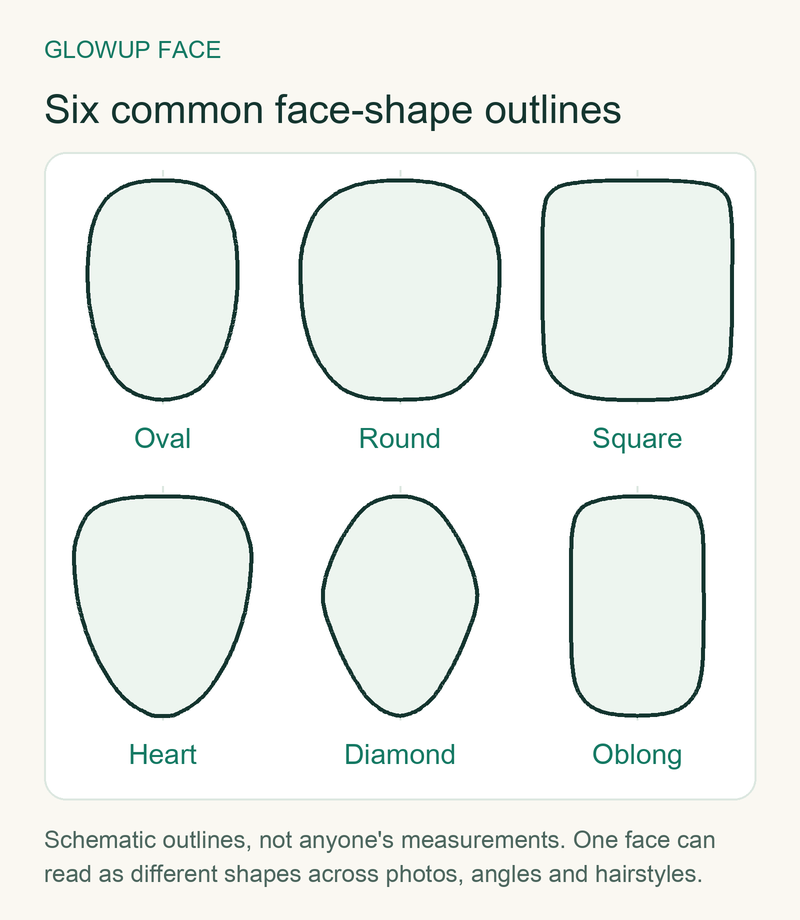
Katherine J. Igoe's 2025 Marie Claire bangs guide calls Grande's face heart-shaped. A 2026 InStyle guide by Nicole Catanese, Krista Carter and Giana Levy takes another view. It places her in the diamond-face section, beside stylist Jennifer Nast's advice for prominent cheekbones and narrower upper and lower outlines.
These pieces are editorial styling calls based on chosen photos, not anatomical assessments. Heart and diamond overlap at a tapered lower outline and defined chin. The split is usually the widest-looking area: forehead for heart, cheek area for diamond. Our guide to what face-shape labels mean explains why neighboring categories can both fit.
What her outline can look like in public photos
In many straight-on public photos, Grande's forehead can read close to the cheek area or slightly broader. The cheek area looks defined, while the jaw narrows through soft corners toward a pointed chin. Her visible outline often reads longer than wide, without the straighter sides associated with an oblong label.
That combination reads as heart when the upper outline looks broad. It can read as diamond when the cheek area dominates or hair narrows the visible forehead. Depending on the photo, either label is a reasonable shorthand. Neither is a permanent fact about her face.
Why the label changes between photos
Camera distance and lens
Perspective starts with camera distance. Derakhshan and colleagues photographed 12 adults across several distances and lens settings for The Laryngoscope in 2024. Close phone shots changed recorded midface dimensions compared with their reference setup. The sample was small, and the study did not test face-shape labels. It still shows why a close selfie and a distant event photo aren't equivalent.
Lens choice matters because it changes framing and often where the photographer stands. Distance creates the perspective shift; focal length alone is an incomplete explanation. For a practical retake setup, see how selfies can alter face shape.
Head angle
A slight turn hides part of one cheek and changes the visible jaw border. Tilting up or down also changes which outline dominates. Mezentseva and colleagues compared two head-position protocols in Buryat and Russian groups in Annals of Human Biology in 2025. They found systematic shape differences between positions, so one angled portrait can't settle a category.
Expression
A smile lifts the cheeks and changes the mouth and lower-face outline. Farnell and colleagues compared smiling and neutral portraits from 80 Finnish adults, plus dynamic smiles from 60 British adults. Their 2018 Journal of Imaging study found expression contributed to recorded shape variation. That does not decide anyone's label, but it supports comparing neutral expressions for a steadier outline.
Hair and the photo's year
Hair can hide the exact features used for the label, and fringe changes how much forehead you see. Face-framing pieces can cover jaw corners, while a pulled-back style exposes the border. The photo's year adds context because parts, cuts, brows, camera gear and editing conventions change over time.
Compare photos from the same period only if the styling and camera setup are similar. A new hairstyle can change the read without changing the underlying outline.
Turn the label into styling options
Copying a celebrity label is less useful than finding the outline feature you share. Start with one visible cue, then choose a reversible way to frame it. Hair texture, density, natural brow growth and frame fit can override any face-shape rule.
The method below maps a visible cue to a common photo variable, then offers one styling option. It is an illustrative editorial guide, not a measured test or predicted result.
| Outline feature | Why it can read differently between photos | Styling option for a reader with that feature |
|---|---|---|
| Upper outline looks broader than the jaw | Fringe can hide the forehead; a turned head can narrow one side. | Try a side part or soft curtain fringe, with some fullness near the jaw. |
| Cheek area looks widest | A three-quarter pose, hard light or tucked hair can emphasize the cheeks. | Try soft layers or frames with gentle curves; check cheek clearance first. |
| Jaw narrows toward a defined chin | A smile and downward camera position can sharpen or soften the lower outline. | Try a chin-length bob, waves near the jaw or a softly angled brow. |
| Outline reads longer than wide | Top volume, tight side styling and close cropping can add apparent length. | Try side volume or frames with more vertical depth instead of extra height. |
If your own outline is heart-like, the heart-face hairstyle hub for women gives cut ideas to discuss with a stylist. Treat them as options because your texture, daily routine and preferred length matter more than matching a celebrity.
For brows, keep your natural growth as the base. A soft curve can echo a tapered outline, while a straighter shape can add horizontal emphasis. The brow-shape guide explains how to adjust without forcing a template.
For glasses, face-shape contrast comes after fit. Check bridge stability, pupil placement, temple comfort and cheek clearance before choosing curves or angles. Our glasses-frame guide separates style from fit.
Check your own outline in a comparable photo
Use one controlled front photo before deciding between heart and diamond. This won't prove a fixed category, but it removes the biggest photo variables.
- Stand in even light and move hair away from your forehead and jaw.
- Keep the camera at eye level, step back and crop the photo afterward.
- Face forward with a relaxed expression and your head straight.
- Compare the forehead, cheek area and jaw border before naming a shape.
You can then use the face-shape finder for your own outline. It estimates the visible shape from a front photo and can show a nearby alternative. Treat the output as styling shorthand, not anatomy. If heart appears, compare it with diamond before choosing a haircut, brow or frame.

Oscar Nascimento
Editorial writer, GlowUp Face
Oscar writes about evidence-based skin care, healthcare, looksmaxxing, and the social and economic research surrounding appearance.
Full profile and all articles →


